The need
Before I arrived, the radio's old website had crashed beyond recovery. Fréquence Amitié no longer had any online presence, its volunteer hosts could no longer publish anything, and nobody could track the audience.
The starting question: how do you give the radio a modern online presence again, and make its hosts self-sufficient, when you have to start from scratch?
What I built, step by step
- The foundations: database and APIA 13-table MySQL database linked by foreign keys (deleting a show automatically deletes its podcasts). A PHP API that validates data and responds in JSON, with prepared statements against SQL injection.
- Accounts and securityPasswords hashed with bcrypt, three roles (member, host, administrator), email verification and Google sign-in.
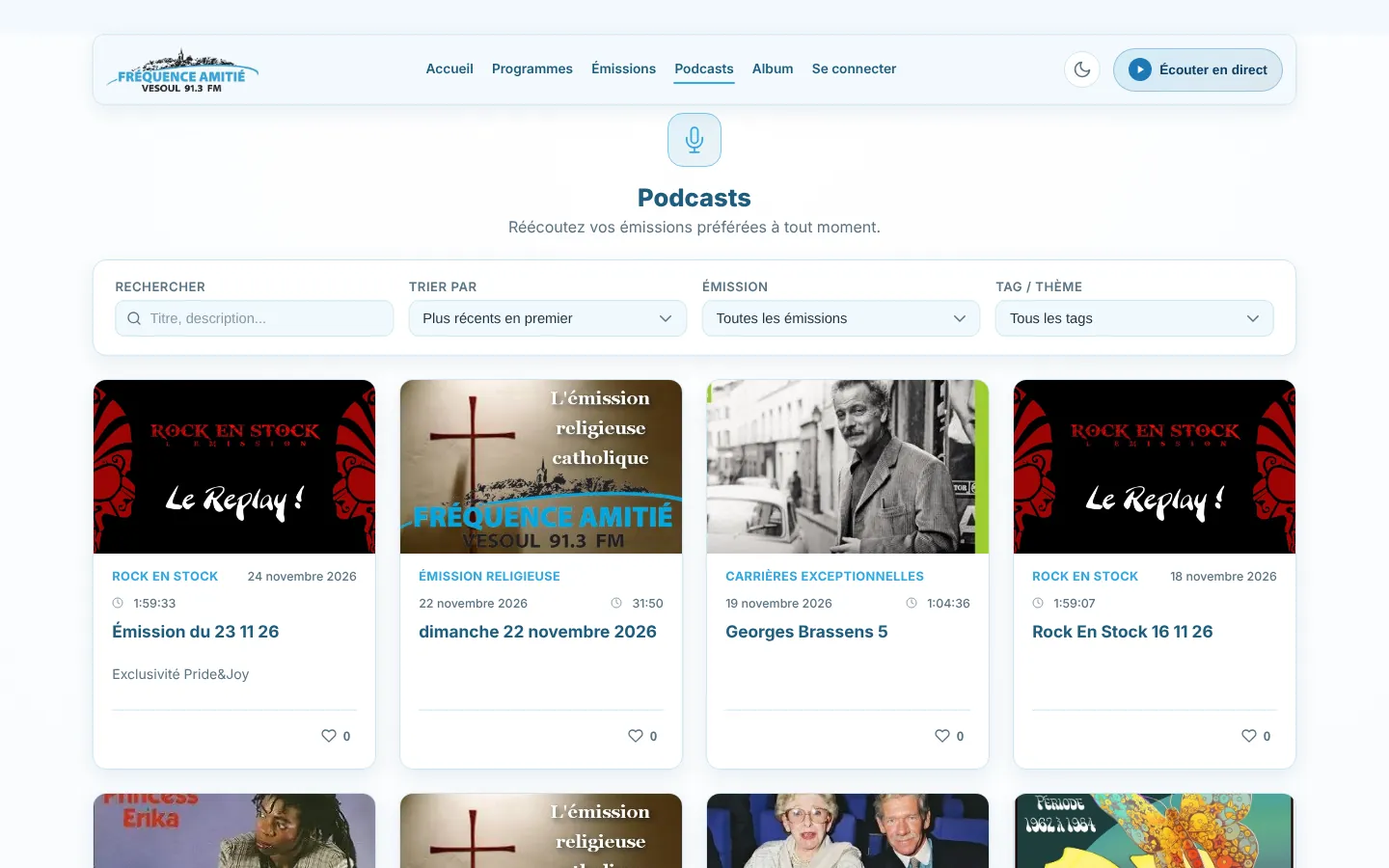
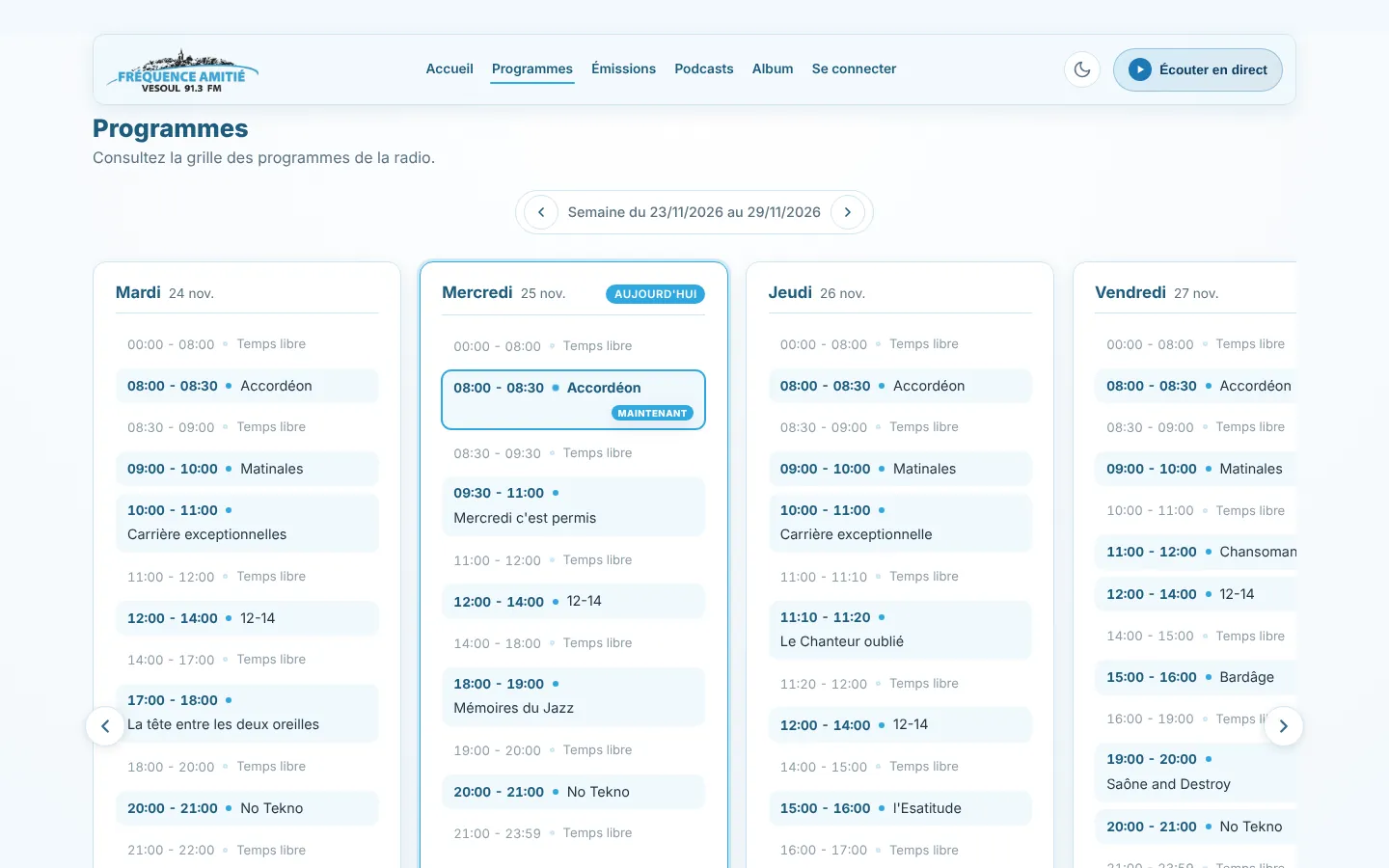
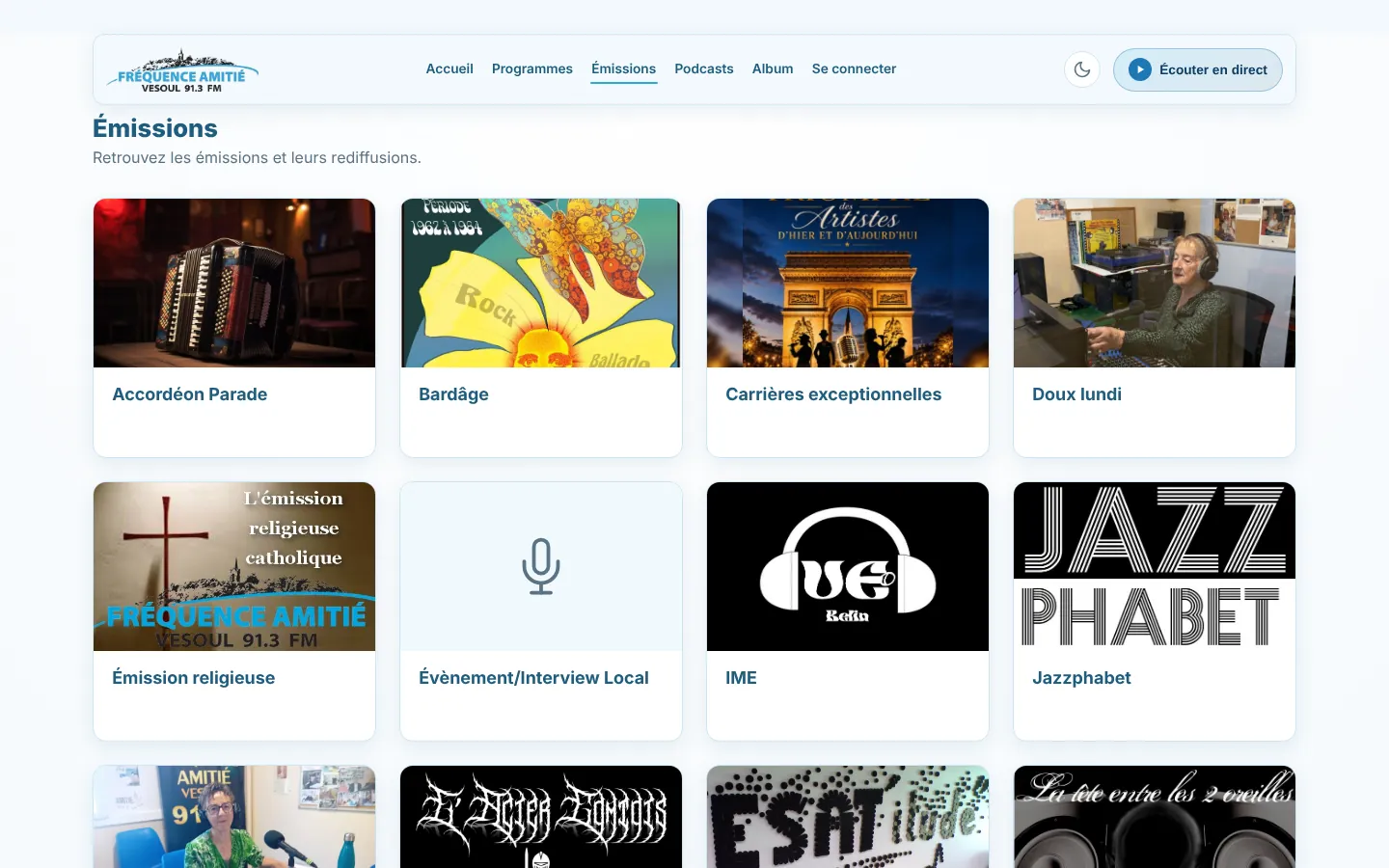
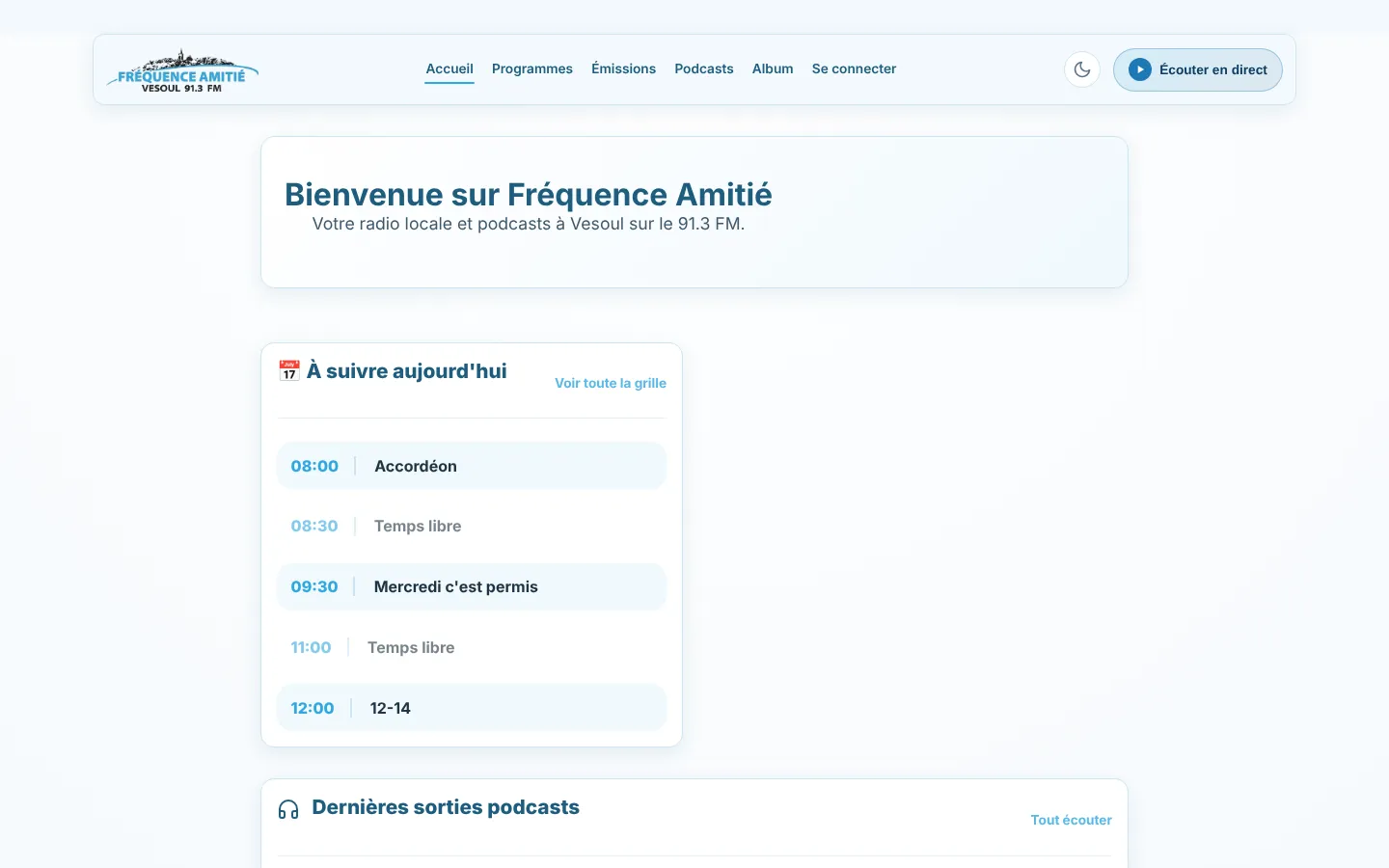
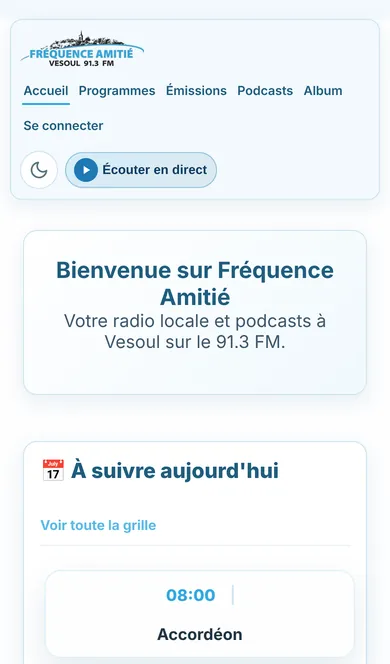
- The interfaceA single-page application in Vue 3: pages change without reloading. Program schedule, show pages, podcasts with search and filters, a live radio player and dark mode.
- The block-based CMS and podcastsEach host builds their show's page by dragging and dropping blocks (text, image, banner) with a live preview, without writing a line of code. They also publish their own podcasts.
- Listening statisticsEvery play is recorded, then aggregated in SQL. Chart.js displays the number of plays, the average listening time and the most popular podcasts.
- Going to productionDeployment on the radio's OVH hosting, including Apache server configuration (URL rewriting, upload limits). A completely new step for me.
Technical challenges and solutions
-
Uploading 250 MB podcasts
The problem
A web server limits the size of the files you can send it, yet a podcast can weigh up to 250 MB.My solution
The browser splits the file into small chunks sent one by one. The server stores them, then stitches them back together as a stream, without ever loading the whole file into memory. The file is only published if its final size is exact.upload-chunk.php (excerpt) function mergeChunks(string $tempDir, int $totalChunks, int $expectedSize, string $finalPath): void { $partPath = $tempDir . '/merged.part'; $out = fopen($partPath, 'wb'); for ($i = 0; $i < $totalChunks; $i++) { $in = fopen($tempDir . '/chunk_' . $i, 'rb'); stream_copy_to_stream($in, $out); // stream copy fclose($in); } fclose($out); // Published only if complete if (filesize($partPath) !== $expectedSize || !rename($partPath, $finalPath)) { @unlink($partPath); throw new RuntimeException('Fichier incomplet.'); } } -
One API, two applications
The problem
While I was building the website, another intern was developing the Android mobile app, which had to use the same data.My solution
Design a clear API that both clients can reuse, and agree on a shared design guide so the site and the app stay consistent. -
Starting from a blank page
The problem
Nothing could be salvaged from the old site: no code, no data structure.My solution
Model the radio's entire domain before writing a single line: accounts, shows, podcasts and the listening log, with referential integrity and indexes on the busiest tables.
The result
The platform is live at frequenceamitievesoul.fr and the radio now publishes on its own. I went beyond the original brief with the block-based CMS, statistics, a support messaging system, Google sign-in and dark mode.
After the internship: maintenance
The project didn't end with the internship. I kept improving the platform, then set up my own development business in September 2026: the radio became my first client, and since November 2026, I have been maintaining its website and web radio as a freelance developer.
- July 2026Switched the live player to the web radio's new stream address.
- August 2026Added an advertising space for the radio's advertisers.
- October 2026Security fixes, session handling fixes, error logging, a redesigned advertiser page and the move to the new web radio.
- November 2026Reworked chunked file uploads to fix a podcast publishing bug.
What I learned
My biggest progress was in deployment, which I knew nothing about. I also learned to run a complete project on my own, from gathering requirements to delivery, working in iterations.
Looking back, I would further strengthen authentication security, add automated tests to make changes safer, and work on accessibility. Push notifications, on both the site and the mobile app, would be a nice next step.